
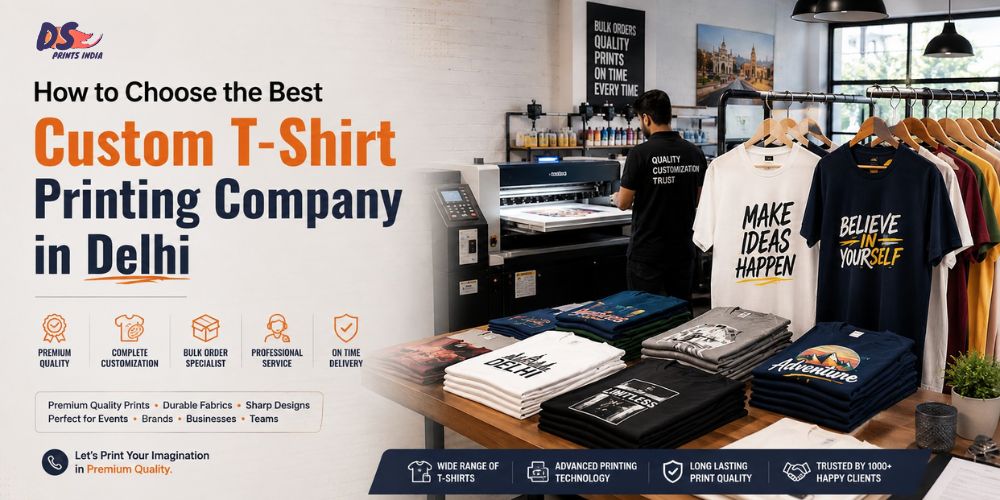
The best company for custom T-shirt printing in Delhi is the one that recommends screen printing, DTF, DTG, or sublimation based on your fabric, quantity, and design — not the machine they happen to own. Here's every check to run before you pay a single rupee in advance.
A T-shirt represents whoever's wearing it
T-shirt printing in Delhi covers everything from corporate uniforms and company-logo tees to promotional giveaways, college fest merchandise, sports jerseys, and NGO campaign wear. Delhi NCR has thousands of printers — home-based sellers in Karol Bagh, export-scale units in Gurugram and Noida — and the price of a basic single-colour cotton tee can swing anywhere from ₹150 to ₹600. That gap isn't random: it comes down to fabric GSM, printing technique, ink quality, and whether you're paying a manufacturer or a middleman reseller.
Getting it wrong doesn't just cost money — it means faded logos two washes in, unusable merchandise on event day, or a deadline you can't recover from. The goal isn't the cheapest quote. It's the supplier who can prove, on paper and in samples, that they'll deliver what they promise.
13 checks, in the order that actually matters
Run through these before you shortlist anyone offering custom T-shirt printing in Delhi.
Define your actual requirement
Quantity, who'll wear it, budget per piece, fabric preference, design complexity, print placement, and hard delivery date — settle these before contacting anyone. Your purpose should drive the fabric and method, not the other way round.
Match the method to your design and quantity
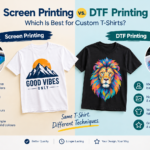
A genuinely expert printer asks about your fabric and quantity before quoting a technique. If they push one method regardless of use case, it's usually the only machine they own — see the comparison table below.
Never ignore fabric quality and GSM
Confirm composition, GSM, and whether the fabric is bio-washed or pre-shrunk. Ask to inspect a physical swatch. Higher GSM isn't automatically better — it depends on whether you need a light giveaway tee or a heavy-duty uniform.
Verify experience — don't just trust it
Check the GST portal for registration and filing history, ask for Udyam/MSME registration if they claim to manufacture, request a video walkthrough of the production floor, and check if Google reviews are spread naturally over years, not clustered.
Check where else they show up
Google Business Profile with 50+ reviews and a realistic rating (4.2–4.7, not a flat 5.0), Justdial/IndiaMART verified badges, customer-tagged delivery photos on social, and named B2B clients you can independently verify.
Get paperwork, not promises
Insist on a written itemised quote, GST-compliant invoicing, a clear reprint/return policy, reasonable advance terms (30–50%, never 100% upfront), and sample approval before full production.
Ask for a physical sample
A digital mockup isn't a finished garment. For 100+ piece orders, check print sharpness, colour accuracy, alignment, fabric feel, stitching, and whether the print cracks when stretched — before committing to the full run.
Compare quotes on value, not price
A lower number isn't cheaper once you factor in fabric composition, GSM, print colours, GST, delivery, and setup charges. Get a fully itemised quotation so you know exactly what you're paying for.
Understand their production model
Ask whether they manufacture and print in-house or outsource. Neither is inherently bad, but it tells you who's accountable for delays and how fast corrections get made.
Evaluate quality control
A strong process checks size, colour, print placement, and final quantity before dispatch, with a clear replacement policy — not a dispute-by-dispute negotiation.
Lock the delivery timeline in writing
Sample approval, production, dispatch, and delivery dates. Standard bulk turnaround (100+ pieces) is typically 5–10 working days after sample approval, longer during fest season (Sept–Dec).
Check the minimum order quantity
Screen printing usually needs 25–50 pieces to be cost-effective; DTF/DTG often accept orders as low as 1 piece. If a quote looks unusually low, confirm it actually applies to your quantity and method.
Consider location and logistics
Proximity helps with sample pickup and issue resolution — see the Delhi NCR map below — but it shouldn't outweigh quality and reliability.
Which printing technique fits your order?
Bulk + simple → screen printing. Small + detailed → DTF or DTG. Sportswear → sublimation. Premium corporate logos → embroidery. Names and numbers → vinyl.
| Method | Best for | Durability | Typical MOQ | Cost / piece |
|---|---|---|---|---|
| Screen Printing | Bulk orders, 1–3 colours, simple logos | High (50+ washes) | 25–50 pcs | Low at scale |
| DTF (Direct-to-Film) | Small batches, multi-colour, detailed art | High (30–40+ washes) | 1–10 pcs | Medium |
| DTG (Direct-to-Garment) | Photo-quality, gradients, one-offs | Medium–High | As low as 1 pc | Medium–High |
| Sublimation | Polyester/dry-fit, jerseys, all-over prints | Very high on poly | 10+ pcs | Medium |
| Embroidery | Premium corporate polos, small logos | Very high | Varies | Medium–High |
| Vinyl / Heat Transfer | Names, numbers, single small designs | Medium | 1 pc | Low |
Where to look, by what you need
Proximity helps with sample pickup and issue resolution — but it shouldn't outweigh quality and reliability.
The right printer depends on the job
Bulk (100–1,000+ pieces)
Prioritise production capacity and batch consistency — ask how colour consistency is maintained across the full run, and whether every piece comes from the same fabric batch.
Corporate uniforms
Prioritise consistent brand colours, clean logo printing, GST invoicing, and repeat-order reliability, since uniforms get worn and washed repeatedly.
Promotions & events
Prioritise a hard delivery deadline and correct sizes/quantities. Share your event date before requesting a quote, not after.
Small, personal orders
Prioritise design flexibility and print quality over bulk pricing — a DTF or DTG supplier is usually the better fit.
Common mistakes buyers make
- Choosing only on price — the cheapest option often means thinner fabric or a mismatched method
- Skipping the sample stage — a mockup is not a finished product
- Ignoring fabric specifications — always confirm composition and GSM in writing
- Picking the wrong method for the artwork — a great design can look poor with the wrong technique
- Not confirming the full price — get GST, delivery, and setup charges in writing upfront
- Ordering without a delivery commitment — always lock in a real date
- Not ordering a buffer quantity — keep a few extra pieces for size changes or last-minute needs
The complete vetting checklist
Run any vendor offering custom T-shirt printing in Delhi through this list.
- They asked about my fabric, quantity, and use case before recommending a method
- GST number provided and verified on the GST portal
- Udyam/MSME registration confirmed (if claiming to be a manufacturer)
- 50+ independently verifiable reviews across at least two platforms
- Willing to share contact details of past clients
- Provided a written, fully itemised quote
- Clear reprint / defect / return policy in writing
- Physical address or video-verified production floor
- Sample or pre-production approval offered before bulk production
- Realistic turnaround time with a stated contingency plan
- Advance payment terms are reasonable (30–50%, not 100% upfront)
15 questions to ask any printer
A supplier who answers these clearly, without stalling, is far easier to trust than one focused only on closing the sale.
- Which printing method do you recommend for my design, and why?
- What fabric and GSM will you use?
- Can I see a physical sample before bulk production?
- Is the quoted price inclusive of printing, setup, and GST?
- Are delivery charges included?
- What is your minimum order quantity?
- How long will production take, start to finish?
- What happens if the order is delayed?
- What happens if some pieces are defective?
- Do you manufacture and print in-house, or outsource?
- Can you share examples of similar past orders?
- Have you handled an order this size before?
- What are your payment and advance terms?
- Can I speak with a recent client as a reference?
- What is your wash-care recommendation for this print method?
Get your fabric, quantity, and deadline ready
Share them with DS Prints India and we'll recommend the right method, show you a physical sample, and give you a written, itemised quote before production starts.
Quick answers
It depends on the method. Screen printing usually needs 25–50 pieces to be cost-effective, while DTF and DTG suppliers often accept orders as low as a single piece — ideal if you just want a few customised T-shirts rather than a bulk run.
Standard turnaround for 100+ pieces is typically 5–10 working days after sample approval, and longer during fest season (September to December). Always get the sample-approval, production, dispatch, and delivery dates confirmed in writing.
No. Reasonable advance terms sit around 30–50% upfront, with the balance due closer to dispatch or on delivery. Be cautious of any supplier asking for full payment before production starts.
Check whether Google Business Profile reviews are spread naturally over years rather than clustered in a short window, which is often a sign of purchased reviews. A realistic rating sits around 4.2–4.7 — a flat 5.0 across hundreds of reviews is worth a closer look.
Bulk orders with one to three colours suit screen printing best. Small batches with detailed, multi-colour art suit DTF or DTG. Sportswear and all-over prints on polyester suit sublimation. A good supplier asks about your fabric and quantity before recommending one.