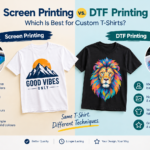
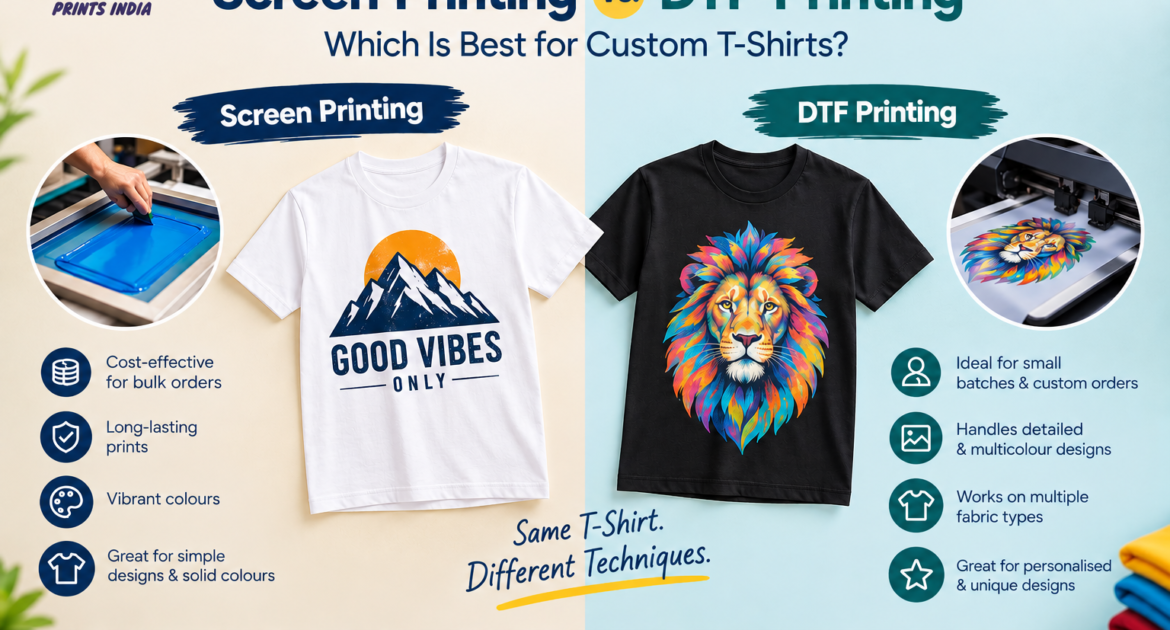
Custom T-shirts are popular with clothing brands, businesses, schools, event organizers, and individuals. But choosing the right T-shirt printing method can make a big difference to the final look, feel, durability, and cost of your order. Two widely used options are screen printing and direct-to-film (DTF) printing.
When comparing Screen Printing vs. DTF Printing, the best choice depends on how many T-shirts you need, how detailed your artwork is, whether each garment needs a different design, and your budget. Screen printing is often suitable for larger batches of the same design, while DTF printing offers flexibility for smaller orders and complex, multicolour artwork.
In this guide, we explain how both methods work, compare their benefits and limitations, and help you choose the right option for your custom T-shirts.
- What Is Screen Printing?
- What Is DTF Printing?
- Screen Printing vs. DTF Printing: Key Differences
- Which Printing Method Is Cheaper?
- Which Method Offers Better Print Quality?
- Which Printing Method Lasts Longer?
- Best Printing Method for Different Needs
- Environmental Considerations
- How to Choose the Right Printing Method
- Order Custom T-Shirts from DS Prints India
- Conclusion
- Frequently Asked Questions
What Is Screen Printing?
Screen printing is a traditional printing method that uses a mesh screen, ink, and a squeegee to transfer a design onto fabric. The ink is pushed through selected areas of the screen to create the artwork. Designs with multiple colours may require a separate screen for each colour.
This method is commonly used for bulk T-shirt orders, uniforms, promotional clothing, and branded merchandise—especially when many garments share the same design.
Benefits of Screen Printing
- Cost-effective for larger orders: Initial setup costs are spread across more garments, often reducing the cost per T-shirt.
- Durable results: When the correct ink and curing process are used, screen prints can withstand repeated washing and normal wear.
- Bold colours: It can produce bright, opaque colours on a range of suitable fabric shades.
- Special ink options: Depending on the printer, techniques and inks can create effects such as puff, metallic, or textured finishes.
- Consistent bulk production: The same design can be reproduced across a large batch with consistent results.
Limitations of Screen Printing
- Preparing screens creates upfront setup costs, which can make very small orders less economical.
- Designs with many colours can require additional preparation and production steps.
- Photographs, fine details, and colour gradients may need specialised techniques.
- Changing the artwork once production has started can add time and expense.
Planning a Bulk T-Shirt Order?
Discuss your design, quantity, and preferred finish before selecting a printing method.
What Is DTF Printing?
Direct-to-film (DTF) printing is a digital process in which a design is printed onto a special film using suitable inks. An adhesive powder is applied, and the design is then transferred from the film to the garment using heat and pressure.
Because the design is printed digitally, DTF can reproduce intricate graphics, photographs, gradients, and multicolour artwork without preparing a separate screen for every colour. It is often useful for customised clothing, small business merchandise, team T-shirts, and personalised apparel.
Advantages of DTF Printing
- Suitable for small orders: It can be practical for short runs because it does not require the same screen setup as traditional screen printing.
- Detailed artwork: DTF can reproduce complex images, fine details, and multicolour designs.
- Personalisation: Names, numbers, logos, and graphics can vary between garments in the same order.
- Fabric flexibility: It can be used on cotton, polyester, and some fabric blends when the transfer materials and application process are compatible with the garment.
- Digital workflow: Different colours can be included in the artwork without making a separate screen for each colour.
Limitations of DTF Printing
- The transfer layer may feel more noticeable than some lighter screen prints.
- Large areas of solid transfer can affect the fabric's breathability.
- Print longevity depends on film and adhesive quality, application temperature, pressure, fabric, and care.
- The cost per garment may be higher for large batches of identical designs.
- Production requires suitable printing equipment and heat-transfer settings.
Screen Printing vs. DTF Printing: Key Differences
The main difference between these methods is how the design reaches the fabric. Screen printing pushes ink through a mesh screen, while DTF printing transfers a digitally printed design from film using heat and adhesive. Each method can be a good choice when matched to the right project.
| Feature | Screen Printing | DTF Printing |
|---|---|---|
| Printing process | Ink is applied through a prepared screen | A digitally printed design is transferred from film |
| Initial setup | Screen preparation is required | Digital artwork and transfer preparation are required |
| Small quantities | Can be less economical because of setup costs | Often suitable for short runs |
| Bulk orders | Often cost-effective for large batches of the same design | May have a higher per-piece cost for large identical batches |
| Design complexity | Well suited to suitable bold and solid-colour artwork | Works well for detailed, multicolour artwork |
| Gradients and photos | May require specialised techniques | Generally easier to reproduce digitally |
| Print feel | Depends on ink, coverage, and technique | The transfer layer may be noticeable by touch |
| Personalisation | Individual variations may require extra setup | Different names, numbers, or graphics are convenient to produce |
| Production runs | Efficient for repeated designs in larger batches | Flexible for short runs and varied designs |
Actual cost and print results depend on the artwork, garment, fabric, equipment, production method, and quantity. Ask your printer to assess the design and provide a quote for your specific requirements.
Which Printing Method Is Cheaper?
When comparing Screen Printing vs. DTF Printing, the cheaper option usually depends on the number of garments and the complexity of the design. It is best to compare quotes for the same T-shirt, print dimensions, colours, and order quantity.
Screen Printing Costs
Screen printing involves preparing screens and setting up the production process. These initial costs are spread over the total order, so the per-T-shirt cost can become more economical as the quantity increases. For example, a large order of identical T-shirts with a simple company logo may be a good candidate for screen printing.
DTF Printing Costs
DTF printing generally requires less screen-related setup for each design, making it a practical option for small batches and personalised orders. It can be useful when individual T-shirts need different names, numbers, or graphics. However, for a large quantity of identical garments, screen printing may offer better value.
Tip: Request quotes for both methods using the same garment type, artwork size, colour requirements, and quantity. Compare the full cost—not just the price per print.
Which Method Offers Better Print Quality?
Print quality depends on the artwork, ink or transfer materials, fabric, equipment, and production technique. Neither method is automatically better for every design.
Screen printing is often suitable for bold logos, simple illustrations, and designs with solid colours. It can create strong colour saturation and a professional finish, especially on repeated bulk orders.
DTF printing is often suitable for detailed illustrations, photographs, fine lines, gradients, and artwork containing many colours. Its digital workflow offers flexibility when a design has intricate details.
Print feel also matters. If you want a lightweight finish, ask the printer about ink or transfer type, print coverage, fabric compatibility, and available finishing options. You can also review examples in the DS Prints India gallery.
Which Printing Method Lasts Longer?
Both screen printing and DTF printing can produce durable results when the right materials and production settings are used. Longevity also depends on the garment fabric, print coverage, curing or transfer process, and how the T-shirt is washed and dried.
Screen prints can last through many washes when suitable ink is properly cured. DTF prints can also be durable when quality transfer materials and correct heat, pressure, and application settings are used. Poor application or improper care can cause a print to crack, peel, or fade sooner than expected.
Tips to Make Printed T-Shirts Last Longer
- Follow the printer's garment-care and washing instructions.
- Turn T-shirts inside out before washing.
- Use an appropriate wash cycle and avoid excessive heat.
- Avoid harsh chemicals that could damage the print.
- Follow garment-specific drying and ironing recommendations.
For a large order, ask the supplier for care instructions and, where possible, sample garments to assess before production.
Best Printing Method for Different Needs
The right choice depends on your business, order size, design, and whether every garment needs the same print.
1. Clothing Brands
A clothing brand producing many garments with the same suitable design may prefer screen printing for larger runs. DTF can be more flexible for limited-edition releases, detailed artwork, samples, or smaller batches while a brand tests customer demand.
2. Corporate Gifts and Promotional T-Shirts
Businesses ordering branded apparel for staff, trade shows, or promotional campaigns should consider both quantity and design. Screen printing can suit bulk orders with a consistent logo, while DTF may be convenient for smaller quantities or multicolour artwork. Explore custom T-shirt printing services for business and promotional requirements.
3. Schools, Colleges, and Events
For school functions, college festivals, sports meets, and group activities, screen printing can work well when everyone needs the same design. DTF can make it easier to include different names, numbers, or graphics across a smaller order.
4. Small Businesses and Startups
Startups and small clothing businesses may want to test a design without ordering a large quantity of stock. DTF offers flexibility for small runs and varied designs. If demand grows and larger batches of the same design are needed, screen printing may become an attractive option.
Environmental Considerations
Neither printing method is automatically more environmentally friendly in every situation. Screen printing may involve screen-cleaning products, water, and unused ink. DTF printing can involve transfer film, adhesive powder, inks, and production waste.
The overall impact depends on the equipment, consumables, waste-management practices, fabric, and efficiency of the production process. To make a more considered choice, ask your supplier about waste reduction and materials, and order a quantity that matches your actual needs to help avoid overproduction.
How to Choose the Right Printing Method
Before placing an order, consider these five questions:
1. How Many T-Shirts Do You Need?
For larger quantities of the same design, screen printing may offer better value. For small batches, DTF may be more suitable. The best option still depends on the supplier's pricing and production setup.
2. How Complex Is Your Design?
Bold artwork with a limited number of colours can be well suited to screen printing. Photographs, gradients, and intricate multicolour graphics are often easier to produce using DTF.
3. Does Every T-Shirt Need a Different Design?
If you need different names, numbers, or graphics on individual garments, DTF can make those variations more convenient to manage.
4. What Print Feel and Finish Do You Want?
Consider the print's texture, coverage, and breathability. Ask to see a sample on a similar fabric before confirming a large order.
5. What Is Your Total Budget?
Compare the complete quote, including garments, setup, printing, finishing, and any other production costs. The lowest price per print is not always the best value if it does not meet your quality requirements.
Need Custom T-Shirts for Your Brand or Event?
Share your design, quantity, fabric preference, and budget to explore a suitable printing solution.
Order Custom T-Shirts from DS Prints India
DS Prints India helps customers explore custom T-shirt options for businesses, events, clothing brands, and promotional needs. Before placing your order, consider your artwork, garment type, required quantity, and preferred finish so the most suitable printing method can be discussed.
Browse the T-shirt collection or view options such as round-neck T-shirts and polo T-shirts. For a project-specific estimate, visit the request a quote page.
👉 Start Your Custom T-Shirt Order
Contact DS Prints India to discuss your artwork, order size, garment options, and printing requirements.
Conclusion: Which Is Best for Custom T-Shirts?
There is no single winner in the Screen Printing vs. DTF Printing comparison. Both methods are useful when matched to the right job.
Screen printing is often the better choice for larger orders of identical T-shirts, especially when the design uses suitable bold or solid colours and keeping the per-shirt cost low is important. DTF printing is often a strong option for smaller quantities, detailed artwork, multiple colours, and individual customisation.
The best decision comes down to your order volume, design, fabric, print feel, durability needs, and budget. Discuss these factors with your printing provider and compare quotes before placing your order.
Ready to plan your order? Contact DS Prints India to discuss custom T-shirts for your business, event, or clothing brand.
Frequently Asked Questions
TTF Printing is almost always more convenient for small orders and intricate designs, while screen printing is often a more practical choice for large orders with repeated designs. It all depends on what you need, and how much you can spend.
Yes. DTG printing is appropriate for many custom t-shirt applications, such as personalised gifts, elaborate images, multicolour logos, and small clothing orders. Ensure the right fabric and application are used.
It can also be cheaper when printing the same design on a large number of garments, because the set-up costs are amortized over the many garments. Actual prices vary between printers, artwork, fabric and quantity of garments printed.
Cracked or Peeling DTF is a result of the transfer sheets being of substandard quality, the application process used was not applied correctly, or the apparel was not washed or maintained properly. Proper application and following the wash instructions will help preserve print quality.
Yes, However, both methods are safe for cotton T-shirts when the ink or transfer materials and application method are appropriate for this particular textile.